East Africa development: A review of a decade of hard work
Over the years, this publication has remained optimistic regarding economic and infrastructure development
Lamu Port in Kenya: From concept to reality
in East Africa. You would be forgiven if you say I bucked the trend. We were optimistic that promises will turn into reality. We broke the ground with incisive reports on infrastructure projects in the region, many of which were at design or early implementation stages. Contrary to journalistic cynical instinct, we remained optimistic even when the odds appeared to weigh against us.
In the process, we gained insights not readily available in publications of this type. Time has always been both my enemy and ally.I allow time to prove me wrong or right. Looking back 10=15 years ago, time has not proven us wrong.
Time to take stock of the progress of progress in the region. When this publication was born in 2012, China was beginning to make inroads into Africa and it faced a lot of opposition and propaganda brewed in the West. Despite this, China financed -and built-projects in the region that have resulted in visible developments.
Let’s Start with transport infrastructure: The entire East Africa was ringed by metre gauge railway system, which was collapsing. It boasted of a total of 9.000 Kilometres of paved roads. Kenyan then boasted of roughly 4000Kilometres of these while Tanzania was distant second with roughly 2000Kms.
China and African Development Bank, AfDB,have emerged and the top partners in transport infrastructure development in the region over the past decade or so. AfDB funded the Cape town to Cairo, Great North road, which increased the quantity of paved roads in Tanzania, and Kenya. It helped fund some long neglected roads and regions such as the Nairobi- Addis ababa road, Connecting Kenya to Ethiopia. In Tanzania, the project opened southern Tanzania by funding upgrades of roads connecting the region to the Commercial City, Dar-Es-Salaam.
By 2024, the number of paved roads has risen to nearly 50,000 kilometres. Kenya boasted of 25,000 Kilometers. This was a 625 percent increase over a period of slightly more than 10 years. Tanzania had glossed 15,000 kilometres , a 750 percent increase over the same period! Uganda had glossed 6000 Kilometres while Rwanda and Burundi were forging ahead. 
Kampala-Entebbe Highway:
Eased traffic Jams in
Kampala, Uganda,
The result: fast movement of goods and people and increased domestic and international trade.
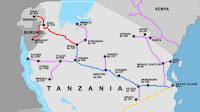
On Railways, Kenya has build more than 700 kilometers of Standard Gauge Railway while Tanzania is a close second with roughly 400Kilometres. Ethiopia still boasts of 750 kilometers Addis-Djibouti SGR line. Kenya is now on Phase 3 extending the line to Malaba, on the border with Uganda. Uganda is constructing its section of the SDR between, Malaba and Entebbe.
This will make The Northern Corridor SGR, the longest in the region at 1250 kilometers. Kenya’ will boast of 1000 kilometres of this, the longest in the region. The Kenya and Ethiopian lines were build by the Chinese despite propaganda against “Chinese Debt diplomacy and subjugation by the Chinese.” None of the Propaganda has come to pass.
In 2012, East Africa boasted of hardly 5000 MW of electricity generating capacity. Ethiopia dominated the scene with Just about 2600 MW. The rest were below 1500MW. Now additional 9.6 GW has been added in the region. Ethiopia leapfrogged ahead when the 6.0 GW Grand Renaissance Dam, GERD, came on stream. Electricity could become Ethiopia’s leading export soon. Other countries in the region have more than doubled their capacity with Kenya and Tanzania having doubled their capacities to more than 3.5 GW and still building. Kenya is the leader is Geothermal power generation in Africa and the seventh in the world, having installed 823 MW , dethroning Italy a from the seventh perch in the world. Geothermal is now the base power load in Kenya whose Geothermal potential is estimated at 10 GW.
Nyerere Bridge Tanzania:
Opened Kigamboni City
Kenya and Uganda have discovered commercially viable crude oil deposits and are building the infrastructure necessary to evacuate crude to the Sea for export. Works on the 1442 Kiliometer long EACOP between Uganda Hoima oil fields and and the Tanga Port in Tanzania is on going. Kenya is yet to begin its own pipeline from Lokichogio Oil fields to Lamu port, some 832 kilometres away.
How ever, the Lamu Port, which forms Part of the Lamu Port-South Sudan -Ethiopia transport corridor is operational with three berths operational. A further five- berths will be constructed as part of the 700,000 bPd , East Africa Petrochemical Plant. The plant’s constriction began less than a month ago. Initially, the Refinery was designed to be a120,000bpd plant but has now been upgraded to the second largest in Africa.
Apart from transport infrastructure, new cities are emerging . Among these is Kigamboni in Tanzania. This suburb of Dar-Es- Salaam after the construction of “the bridge over the sea.” The US$138 million project was completed in 2016 and renamed the Nyerere bridge. Its completion coincided with the areas elevation into a municipal council.
Kigamboni suburb was a 578KM2 of relatively under developed area due to transport handicaps. Situated across the Indian Ocean, its only link to the city was through a ferry at Kivukoni which was a bottleneck. Now, it is linked via a 680 Metre bridge that carries a six-lane road. It is now the headquarters of the Tanzanian Navy and has ambitions of growing into a city.
Konza Digital City in Kenya, the famous Silicon Savannah is a Greenfield project, some 40 KM south-west of Nairobi, Kenya’s capital. Designed to be a digital hub, the 200,000 people city has taken off the ground. Horizontal infrastructure - roads, electricity, drainage and Sewer systems are in place. Vertical expansion with institutions such as local universities setting up shop. Its major source of electricity, the Thwake Dam is expected to come on stream in 2027.
And finally, the economy, both Kenya and Tanzania have entered the Low Middle income countries in the past decade , shedding the tag developing countries. Income per capita has jumped from $850 in Kenya in 2010 to $2250 in 2024. In Tanzania, it has grown from $650 in 2010 to $1800 in 2024. The updated data is not available for both countries but our point has been made. GDP in Kenya has shot up from US$52 billion in 2012 to $151 billion in 2025 while Tanzania has reached $90billion over the same period.
Not every target has been hit. But the region is headed in the right direction. See you 10 years down the road.


Comments
Post a Comment