Posts

Africa should lead in green Industrialization

Image
A Lithium-ion Battery AFRICA should leverage its abundant mineral and green energy wealth to lead in the fourth industrial revolution, experts say. And in this respect, the Democratic Republic of Congo should be the nerve center, they add.  The country is rich in mineral wealth and water. It is thus, suitable for the production of cathode precursor materials for Lithium-Ion batteries, a study has established.  The government has accepted a proposal to set up a Special Economic Zone for this purpose, we can report. Lithium-ion batteries power everything from your Mobile phone to Airplane batteries. Now that the world is shifting to clean energy to power cars, Lithium-Ion is also powering electric vehicles, EVs. The Democratic Republic of Congo produces 70 percent of the world's cobalt, the basic Mineral in Lithium-ion batteries. Cathode precursor materials are the intermediate material between cobalt and finished cathode material. Currently, precursor materials are produced...

Has the SGR benefited anyone?

Image
  A wind power project: Increases power supply  and lower cost of electricity Economists and Engineers, at the conception of a project, begin with a theory of the potential benefits the project will engender to the project area. The benefits at that point are purely anecdotal but are feasible. They then move on to study the area’s characteristics, economic and physical, determine the size of the project service area, the population, and economic activities. The Project’s financial costs and pricing of the service come at the tail end of the study. For instance, at conception, a piped water project is justified on the strength of the economic, health, nutrition, and welfare benefits.  A road project is justified on ease of access to markets, faster travel time, and increased economic activity in the project area. All-weather roads generate more economic activity due to ease of access.  These activities are assigned monetary values which are compared to the financial...

The West treads a path beaten by China

Image
Kenya's SGR build by China: Africa could do with a trans- Africa Railroad. The West has woken up to the reality that investment in infrastructure development is simply not for the private sector. The returns from such investments are way outside the private sector’s definition of returns.  For the private sector, returns are purely financial- profits and dividends. However, returns from infrastructure are both financial and economic. The financial returns count for little as economic returns outweigh the financial returns. Infrastructures are enablers of economic activity as they provide goods and services that raise the productivity - and profitability-of other sectors. That is why governments invest in infrastructure to catalyze robust economic growth. In the last month, the west has launched a total of US$1.5 trillion plans to invest in infrastructure. These are; the US$ 1.2 trillion Infrastructure Act in the US, and the $340 billion Global Gateway initiative launched last w...

Has China’s “infrastructure Diplomacy” in Africa won?

Image
T he Loiyagalan-Suswa High voltage transmission line: Salvaged by Chinese  The delivery of stillborn construction projects in Kenya by CMC Di Ravenna, Grupo Isolux Corsan, and Bechtel Engineering raises the question; why?  Why are Western Civil Engineering companies failing in East Africa? Why Is China succeeding? We eschew the propaganda and focus on Economics and attitude toward Africa for these are the elephant in the house.  Chinese and Western infrastructure investment Models differ. Even their attitude towards Africa is far apart.  In Chinese and Western European models, the public, through the government invests in infrastructure. The US on the other hand, allows the private sector, state governments, and the federal government to invest in infrastructure. This diffusion of responsibility is the reason why the US is suffering a severe case of rotting infrastructure. Although the Chinese and European Models are similar, how much we invest in Infrastr...

Why did Tanzania export gold via Uganda and Burundi in 2020?

Image
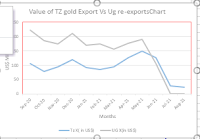
According to the Bank of Tanzania, the country earned US$2.9 billion from gold exports last year.  This, the bank says, was a 32 percent increase over the $2.2 billion earned the previous year.  According to Tanzania invest , the major destinations for Tanzania’s gold exports are South Africa, Switzerland, and India. However, multiple reports indicate that Tanzania used her neighbors, Burundi and Uganda, to export her gold last year. The reports do not explain the shift of destinations to the Middle East via her neighbors. It does not explain the sudden change in consumer behavior in Uganda and Burundi, two countries teetering on poverty, from basic goods to luxuries such as gold. Neither do they explain why Tanzania could not export her gold directly to the market This leaves some hanging questions such as; Did the closure of Airports and Seaports shut the doors to Tanzania’s exports? Was she magnanimous to her neighbors in dire straits? or was she afraid, afraid of what? W...

The West is out to kill Africa’s development agenda

Image
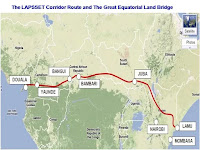
The Equatorial Land  Bridge. Will cut Travel time between East and West Africa to two days  According to the Africa Development Bank’s  Africa Economic Outlook for 2018, Africa needs to invest a total of US$1.2 trillion over the next seven years on productive and profitable infrastructure projects.  This works to an average spend of US$170 billion a year at the top end. Of this, the continent, through budgetary allocations and donor support, can manage $65 billion a year, leaving a yawning gap of US$105 billion or a total of $735 billion over the seven-year period. The AEO breaks down the sectoral needs as follows in order of priority: US$ 35-50 billion on energy, $35-47 billion on transport, and $55-66 billion on water and sanitation That is Africa’s development agenda: Building US$1.7 trillion worth of infrastructure in the next seven years. The question is how to fund the large gap.  To its credit, AfDB has created a vehicle, Africa50, to help craft proj...

Why Kenya's real GDP was larger than the nomial GDP

Image
Source: CBK Data The Rebase of Kenya’s GDP accounting year to 2016 from 2009 has revealed a strange phenomenon: Kenya's real GDP was for six years, larger than the nominal GDP. Nominal GDP, which is the sum of a nation’s wealth at current market prices, is always larger than real GDP. To get the real GDP, Economists deflate the nominal GDP by the consumer price index. That the Kenyan case was the reverse, statisticians explain, suggests that the method and system of data collection were inaccurate. They ignored or missed out on the expansion of the economy.  Real GDP overshot the nominal GDP after the sixth rebase from 2001 to 2009. At that point, real GDP was 164 percent higher than nominal GDP. Nominal GDP was estimated at KES3.3 trillion(US$33 billion) while real GDP rose to KES 5.3 trillion($53billion).  According to the Central Bank of Kenya's historical GDP data, real GDP was consistently higher than nominal GDP between 2009 and 2017 when they coincided at KES7.6 trillio...