Posts

Kenya Pioneers East Africa in PPPs

Image
A prototype of the Mombasa  - Nairobi Expressway Kenya is the pioneer in Public-Private - Partnerships, PPP, in East Africa with a total PPP investment estimated at $6.4 billion already committed. Of these, an estimated $2 billion is already invested in the energy sector. The balance, an estimated $4.2 billion will be sunk into roads construction.   Public-Private- Partnerships are the provision of public services by the private sector for a fee. The private investors charge a toll in case of roads or sign PPAs with the national distributor in case of electricity. Investors sign a 25-year concession during which period they recoup their investment plus profit as they operate the projects they build. All the contracts in the energy sector are on a Build Own and operate (BOO) model while the in road construction contracts are on Build Operate and Transfer (BOT ) model. PPP projects are spread across the country in a strategy designed to ensure equitable development....

East Africa’s GDP to rise by 13 percent- If Weather allows.

Image
Ethiopia's GDP projected  to remain robust    East Africa’s GDP is expected to grow by 13.3 percent to US$340 billion this year, says IMF Database for April 2019. The five largest economies in the region will raise the total regional GDP by US$28.2 billion to control $302.2 billion in 2019 from the $265 billion they controlled last year.   The regional GDP last year stood at US$300 billion, according to the IMF data.   This year, the GDP is expected to rise to $340 billion. Of the five star performers, Kenya and Ethiopia generated 57 percent or $169.5 billion last year.   The star performers including Ethiopia, Kenya, Rwanda, Tanzania, and Uganda will grow by an average of 6.32 percent including Tanzania. But if Tanzania is excluded. The top four will rise by 7.1 percent. Kenya, says the IMF data, will be the leader posting absolute GDP growth of $11 billion, leaving her peers to share the rest of the spoils. In generating such large absolute gro...

Jitters as Tanzanian economy slows

Image
President Magufuli:  dwindling economic fortunes  pose a challenge to his re-election  After years of neglecting due process and imposing unsustainable policies and legislation, the Tanzanian economy is decelerating. According to the IMF database for April 2019, Tanzania’s GDP growth rate has sharply declined from more than 6 percent on average, to 4 percent this year. The rate will remain subdued over the next four to five years says the IMF. This sharply contrasts the country’s optimistic estimates of a 7.3 percent growth this year, up from an alleged 7.2 percent last year. None of the independent reports on the Tanzanian economy supports the government’s position. For instance, the Regional Economic Outlook by the African Development Bank estimates that the GDP grew by 6.6 percent last year. The IMF data agrees with these findings in their review but estimates a sharp 2.7 percentage decline this year which according to IMF gurus, marks the start of the lean p...

The Second Scramble for Africa

Image
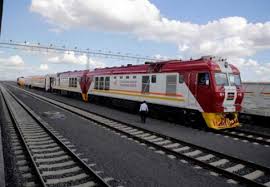
SGR in Kenya. Chinese completed it with 18 months to spare The second scramble for Africa is in top gear.  A few things are different though from the first Scramble. At that time, missionaries led the ‘discovery” of entire Africa with Bibles in their hands. The second scramble targets African resources, that is true, but it is more discrete. Targeted are the large African economies such as Nigeria, Ghana, Ethiopia, and Kenya. The last two economies are the largest in East Africa and are growing robustly. In fact, Ethiopia is among the top ten fast-growing economies in the fast-growing region. Kenya is the more dynamic of the two, with a well- established entrepreneurial culture. The next difference is the drivers of the scramble. In the first scramble, the pathfinders- discoverers if you wish- were Missionaries and explorers. These have been replaced by Government officials and businessmen.  This is not a contest for African resources among European countries. It is ...

Kenya gunning for eighth slot in world geothermal rankings

Image
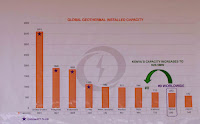
Screengrab of KenGen Presentation Kenya is set to leapfrog Iceland as the world’s eighth largest geothermal producer in the World.  The country will launch its 165.4 Mw Olkaria V power plant in July this year bringing its total geothermal capacity to 855.4 MW, ahead of Iceland’s 710 MW.  And going by the string of investments currently in progress, Kenya could also leapfrog Italy, the “birthplace” of geothermal technology from position seven in a year or two. In fact, Mexico and New Zealand also have their positions seven  and six respectively, threatened by Kenya’s investments. The capacity of these three are Italy 944 MW; Mexico 951 MW and New Zealand 980 MW. All these are within Kenya’s sight which has a penchant for large capacity plants. Currently, there are three projects whose contracts have been approved to generate more than 400 MW of geothermal power in the next three years. These are; Suswa 300MW and Menengai GDC field 105 MW. This is in addition to...

The pitfalls of economic nationalism in Tanzania

Image
Presidents YKM of Uganda and Tanzania's JPM:  Friendship at whose cost? Tanzania is now firmly on an Economic Nationalism path in a bid to create a “fairer economy” for the country and its citizens.  Such policy involves a greater state role in the management of the economy, diminishing the role of markets. However, there are pitfalls that put the success of the path to doubt: Production of marketable goods requires money, equipment, and technical know-how including management. Without these, resource or economic nationalism is a pipe dream for, investors choose to stay away.  The Latin American pioneers in that path do not appear to have gained from the windfall of oil price increases in the early 2000s.  In Venezuela, one of the early advocates of natural resource nationalism, more than 70 percent of the population is reeling in poverty today, and the economy has virtually collapsed. Economic nationalism involves; emasculating dissent, including poli...

Which is the largest Economy in East Africa?

Image
The high flyers: Kenya and Ethiopia Which is the largest economy in East Africa? Interesting question. There is two running neck on neck-Ethiopia and Kenya.  The GDP of both countries has crossed the US$86 billion mark and, at the current rates of growth, will cross the $90 billion Mark in the next 12 to 18 months… well, 10 to 16 months.  When we wrote about the epic rivalry between the two economies, we did not see the reason for the see-saw on the top perch. Now we can confidently report it. It is just a small gap in the GDP accounting periods! Is Ethiopia’s the largest economy in East Africa or is it Kenya’s? A casual glance at GDP data could place Ethiopia at the top or even place Kenya at the top.  You won’t be wrong depending on the time period. But look again: Which is the economic powerhouse in East Africa? There is a six-month hiatus in the GDP accounting periods of the two countries. Kenya accounts for its GDP during a Calendar year (January-Decembe...