Posts

Why the Chinese won’t finance Naivasha-Kisumu Line

Image
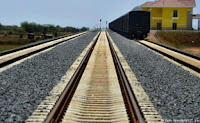
Kenyan SGR: Mombasa-Nairobi Section operational The Naivasha-Kisumu SGR line technically and commercially unviable, we can report. That is why the Chinese cannot finance it. Kenya is, therefore, well advised to focus on the Naivasha-Malaba line which will   link to Uganda and on to Rwanda, Eastern Democratic Republic of Congo, and eventually Juba, in South Sudan. That was the original goal and design of the standard Gauge Railway line, to provide seamless railway connection between Mombasa Port and its hinterland. That would raise its economic and commercial viability. Also, Read  http://eaers.blogspot.com/2013/07/coming-soon-mombasa-kigali-express.html The purpose of a Standard Gauge Railway line is to provide high- speed, cheap, and reliable network for faster transportation of goods and people. The purpose is well served by a line linking Kampala through Malaba than through Lake Victoria. Tunneling Nairobi-Naivasha Section While a high-speed Railway link...

Why Tanzania's lowest budgetary growth in East Africa

Image
IMF's projection of Tanzania's  growth path to 2024  Tanzania has posted the lowest budget growth in the East Africa region. The financial year 2019/2020 budget statements, read simultaneously in five parliaments last week, posted on average a 12.52 percent increase over the last financial year without Tanzania. With Tanzania, the average growth declined to 10.40 percent. The Tanzanian budget increased 1.9 percent over the previous year to US$14.3 billion. The leader is Uganda who posted a 21 percent expansion in the budget to US$10.7 billion; Rwanda 11 percent to $3.16 billion; Kenya 10.3 percent to $30 billion; and Burundi 7.2 percent. Tanzania’s budget rose to Tshs 33.1 trillion ($14.3 billion) from Tshs 32.48 trillion (US$15 billion) in the last financial year.   In absolute terms, the budget expanded by Tshs 600 billion (US$222.8 million). However, depreciation of the local currency reduced the value in US dollar terms compared to the previous year. The...

The cause of Tanzania's "resource Nationalism"

Image
Tanzania's SGR: under Construction According to a recent report on the Construction Magazine, www.constructioreviewonline.com , the 300 Kilometre Dar-Es-Salaam –Morogoro Standard Gauge Railway Line will cost US$1.9 billion.   And in a video clip Broadcast by Tanzania Railways Corporation, TRC,  https://www.youtube.com/watch?v=vrcv3CBi63E , the line, the Minister said, was funded by the Tanzania taxpayer. Eureka! East African watchers say. “This explains the sudden surge in resource nationalism in Tanzania,” said a Nairobi based economist. The line attracted no takers after the fallout with the Chinese in 2015. Yet implementation still went on and the financiers were a mystery. The project was too pricey for the Tanzania budget which was US$15 billion in the 2018/2019 financial year, data crunchers say. Of this, $5.8 billion was set aside to finance development projects,-roads, airports, schools, hospitals, and the Railways line. At $1.9 billion, the line gobbled u...

Kenya’s Killer Punch against Financial crimes

Image
Dr.  Njoroge: Governor Central Bank: He wrongfooted the "mattress bankers"   Financial crimes in Kenya, which includes; theft of public resources, tax evasion and money faking and fraud faces a killer punch. The Central Bank of Kenya has launched new banknotes and immediately demonetized the 1000 shilling note. The banknote is the highest store of value in Kenya and very popular with those involved in financial crimes including fakers. The current one will cease to be a legal tender in four months’ time, on October 1. This is a killer punch because it tightens the noose for “mattress bankers.” Many are, of course, involved in financial crimes. That is why the money cannot be banked for fear it will be traced to them. The rules of retiring the old note are stringent, geared to expose the owners of the money.   This leaves the mattress bankers with only two options: bring it out and answer questions, and perhaps, face the law or go bust.   The option of fac...

Step aside Fintechies,banks re-enter SME lending

Image
Dr. James Mwangi:  EquityBank Group CEO   S ix commercial bank groups in Kenya have resolved to lend to Micro and small enterprises, SMEs. The decision by the six, four of which are the largest banks in the country, will have a significant impact on credit to SMEs. This marks the beginning of a major price war that could benefit the borrower.  Equity Bank group shot the first volley:  It set aside US$1.5 billion to lend to the sector of the economy at 13 percent per annum probably through its EAZZy app. Soon thereafter, a consortium of five indigenous banks launched Stawi, a mobile phone app to lend to the sector amounts ranging from US$300 to $2,500.  The consortium targets some 10,000 applicants this year, which means that at least an additional US$25 million is available for the SMEs to borrow. It is not clear how much Equity will lend per customer, but given the size of its war chest, it could lend more. The consortium includes; Commercial Ba...

Kenya Pioneers East Africa in PPPs

Image
A prototype of the Mombasa  - Nairobi Expressway Kenya is the pioneer in Public-Private - Partnerships, PPP, in East Africa with a total PPP investment estimated at $6.4 billion already committed. Of these, an estimated $2 billion is already invested in the energy sector. The balance, an estimated $4.2 billion will be sunk into roads construction.   Public-Private- Partnerships are the provision of public services by the private sector for a fee. The private investors charge a toll in case of roads or sign PPAs with the national distributor in case of electricity. Investors sign a 25-year concession during which period they recoup their investment plus profit as they operate the projects they build. All the contracts in the energy sector are on a Build Own and operate (BOO) model while the in road construction contracts are on Build Operate and Transfer (BOT ) model. PPP projects are spread across the country in a strategy designed to ensure equitable development....

East Africa’s GDP to rise by 13 percent- If Weather allows.

Image
Ethiopia's GDP projected  to remain robust    East Africa’s GDP is expected to grow by 13.3 percent to US$340 billion this year, says IMF Database for April 2019. The five largest economies in the region will raise the total regional GDP by US$28.2 billion to control $302.2 billion in 2019 from the $265 billion they controlled last year.   The regional GDP last year stood at US$300 billion, according to the IMF data.   This year, the GDP is expected to rise to $340 billion. Of the five star performers, Kenya and Ethiopia generated 57 percent or $169.5 billion last year.   The star performers including Ethiopia, Kenya, Rwanda, Tanzania, and Uganda will grow by an average of 6.32 percent including Tanzania. But if Tanzania is excluded. The top four will rise by 7.1 percent. Kenya, says the IMF data, will be the leader posting absolute GDP growth of $11 billion, leaving her peers to share the rest of the spoils. In generating such large absolute gro...